
Establishment of the Irish Cob Studbook
In early June 1996, Evelyn Flynn (formerly Evelyn Murphy) made a telephone call to the Department of Agriculture in Ireland (henceforth referred to as the Department) and spoke with Department official Mr Brian Walsh. In her conversation, Evelyn proposed establishing the first studbook for the feathered cob, created in Ireland by Irish Travellers. Evelyn explained that because Irish Travellers had not given a name to the breed except ‘the piebald’ (because they were predominantly black and white), she would name the studbook the Irish Cob Studbook (thereby naming the breed for the first time). Evelyn also said that it was necessary to have the Irish Cob Studbook recognised as an official studbook in respect of which official identification documents (passports) could be issued.
Mr Walsh asked Evelyn to put her proposals in writing to the Department, and to assist her he told her that he would send her the relevant EEC (now EU) studbook and identification legislation Decision 92/353/EEC and Decision 93/623/EEC (which were adopted and paired pursuant to Article 4 of Directive 90/427/EEC) and the relevant national regulations S.I. 305/1993 the European Communities (Equine Stud-Book and Competition) Regulations 1993.
On 28th June 1996, Evelyn put her proposals in writing to the Department.
On 18 July 1996, the Department issued a letter to Evelyn recognising her proposed Irish Cob Studbook as an official studbook (as requested by her) and acknowledging her proposal to establish a body (organisation) as Keeper (to maintain) the studbook.

Because the body (organisation or association) Evelyn proposed to establish (found) would establish the proposed Irish Cob Studbook (not the Department), Evelyn had to apply to the Department for approval to be granted to her proposed body (organisation) in accordance with Article 2(1) of Decision 92/353/EEC and therefore for the purpose of maintaining the Irish Cob Studbook as an approved body (organisation) authorised to issue the official identification document (passport) for registered equidae established in Decision 93/623/EEC. However, the application for approval could only be made by Evelyn under Regulation 3(1) of the European Communities (Equine Stud-Book and Competition) Regulations 1993 (S.I. 305/1993), which was legally deficient and misleading (and therefore potentially damaging).
"Regulation 3 of S.I. 305/1993:
‘Approval of bodies for the purposes of maintaining stud-books.
(1) The Minister shall for the purposes of these Regulations and Directive 90/427 grant an approval to an association or organisation whose headquarters are located in the State for the purposes of maintaining a stud-book subject to the provisions of paragraph (2)."
Regulation 3(1) of S.I. 305/1993 was legally deficient and misleading (and therefore potentially damaging) for the following reasons: -
-
Regulation 3(1) of S.I. 305/1993 only provided for a person to be approved 'for the purpose of maintaining a studbook'. Regulation 3(1) of S.I. 305/1993 therefore only provided for an agency (which therefore did not establish, nor therefore own, its own studbook) to be approved to maintain an existing Minister-owned (Department-established) studbook in respect of which the official agency would therefore be authorised to issue official identification documents (passports) for registered equidae on behalf of the Minister. Although Regulation 3(1) of S.I. 305/1993 claims to apply to approval of an organisation or association (an independent body), it only applies to approval of an agency (a Minister-controlled body).
-
Regulation 3(1) of S.I. 305/1993 therefore failed to correct transpose (apply) Decision 92/353/EEC, by failing to provide for an independent organisation or association (such as the Irish Cob Society which established and maintains its own studbook) to be approved in accordance with Article 2(1) of Decision 92/353/EEC for the purpose of maintaining its own studbook as an official studbook in respect of which the organisation or association would therefore be authorised to issue its own official identification documents (passports) for registered equidae in respect of its studbook.
Because independent organisations and associations (such as the Irish Cob Society) which establish (and therefore own) their own studbook are legally entitled to maintain their studbooks (without having be be approved to do so), Regulation 3(1) of S.I. 305/1993 not ony denied the independent organisations and associations (such as the Irish Cob Society) of their fundamental right to to maintain their own studbooks, but Regulation 3(1) of S.I. 305/1993 also denied the independent organisations and association (such as the Irish Cob Society) of their fundamental right to the ownership of their own studbook.
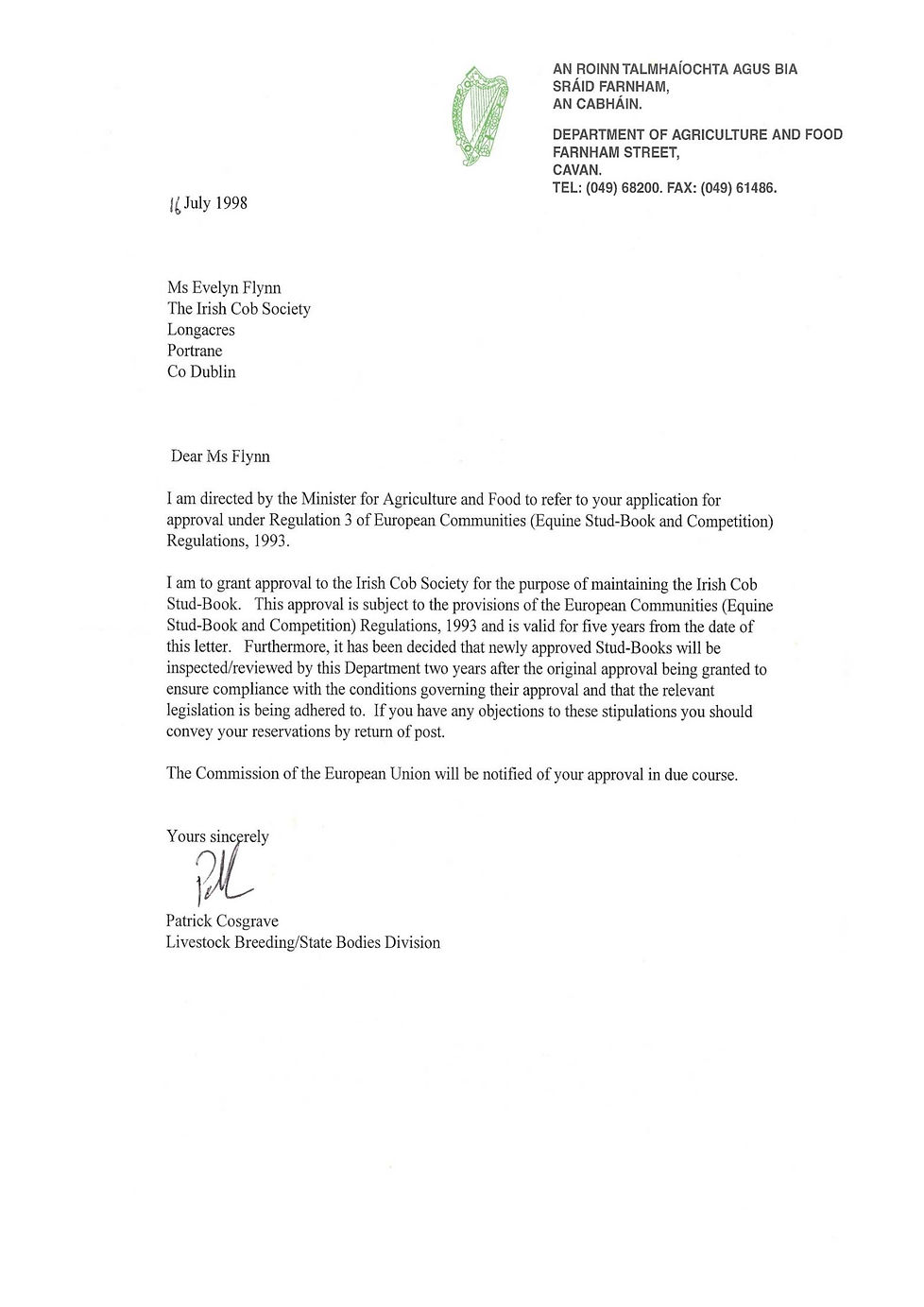
False ICS approval
Because the Irish Cob Society (the proposed body founded by Evelyn) established the Irish Cob Studbook (not the Department), and the Irish Cob Studbook is therefore not a Minister-owned studbook, the approval granted to the Irish Cob Society on 16 July 1998 under the legally deficient and misleading (and therefore potentially dangerous) Regulation 3 of S.I. 305/1993 'for the purpose of maintaining the Irish Cob Studbook' was a false (and therefore potentially damaging) approval of the Irish Cob Society.
Real ICS approval
Despite how the 'approval letter' issued to the Irish Cob Society on 16 July 1998 was framed by the Department, the true approval granted to the Irish Cob Society in accordance with Article 2(1) of Decision 92/353/EEC on 16 July 1998 was for the purpose of maintaining the Irish Cob Studbook (which the Irish Cob Society established and therefore owns) as an official studbook in respect of which the Irish Cob Society was therefore authorised to issue the identification document (passport) for registered equidae established in Decision 93/623/EEC.
The real ICS approval was never withdrawn
Because the real approval which was granted to the Irish Cob Society in accordance with Article 2(1) of Decision 92/353/EEC was to issue equine identification documents (passports) in respect of its Irish Cob Studbook (not to maintain its own Irish Cob Studbook), the only way that the real approval which was granted to the Irish Cob Society in accordance with Article 2(1) of Decision 92/353/EEC (to issue passports in respect of its studbook) could have been legally withdrawn on 29 November 2012 was if the Department had found that the Irish Cob Society no longer met the conditions laid down in the Annex to Decision 92/353/EEC, and the Department had therefore been obliged to withdraw the real approval of the Irish Cob Society (to issue passports in respect of its studbook) in accordance with Article 3 of Decision 92/353/EEC.
However, because the Department did not find (and therefore never produced any evidence that could prove) that the Irish Cob Society no longer met the conditions laid down in the Annex to Decision 92/353/EEC, the real approval of the Irish Cob Society which was granted to the Irish Cob Society in accordance with Article 2(1) of Decision 92/353/EEC (to issue passport in respect of its Irish Cob Studbook) remained valid when the Deparment issued a letter to the Irish Cob Society on 30 November 2012, advising the Irish Cob Society that their false (non-existent) approval of the Irish Cob Society (to maintain its Irish Cob Studbook) was revoked on 29 November 2012.
The real approval of the Irish Cob Society (to issue passports in respect of its Irish Cob Studbook) was therefore still valid when the Department took the Irish Cob Society's Irish Cob Studbook and gave it to Horse Sport Ireland, following the Department's wrong and most damagingly incorrect information given to the Irish Cob Society - i.e. that the Irish Cob Society's approval to maintain the Irish Cob Studbook (and also the Irish Cob Part Bred Studbook, which the Irish Cob Society also established and owns) was revoked on 29 November 2012.